You are here

Frequently Asked Questions: Beach Nourishment Projects

Beach nourishment is a consistent and necessary aspect of life along the coast, specifically in southeastern North Carolina. The process helps build back dunes and berms lost during storms or natural erosion. It also replaces and widens our existing beaches. It is vitally important in protecting our community and infrastructures along the shoreline. Specifically for our area, forms of beach nourishment may be used to deepen and widen paths used by cargo ships as they travel up the coast to the ports of Wilmington.

What is beach nourishment?

Beach nourishment is the process of replacing sand and sediment lost due to erosion and storms. Sand and sediment is dredged from areas offshore and pumped or placed per an engineer's plan. It creates and/or helps fortify the necessary dunes and berms for protection of the coastal area as well as widens the beaches to help reduce further storm damage. In addition, it provides larger beaches with much more space for guests to enjoy!

What is the difference between a dune and a berm? 

A coastal dune is a landform created with wind- or water-driven sand typically found in the shape of a mound, ridge or hill. While they may be found in different shapes and sizes, the dunes typically run parallel to the shore and are an important in the protection of the coastal area. 

A berm is typically the area of beach located on the oceanside of the coastal dune. It is an area of the beach commonly used by vacationers.

How does beach nourishment works to protect the area during a storm?

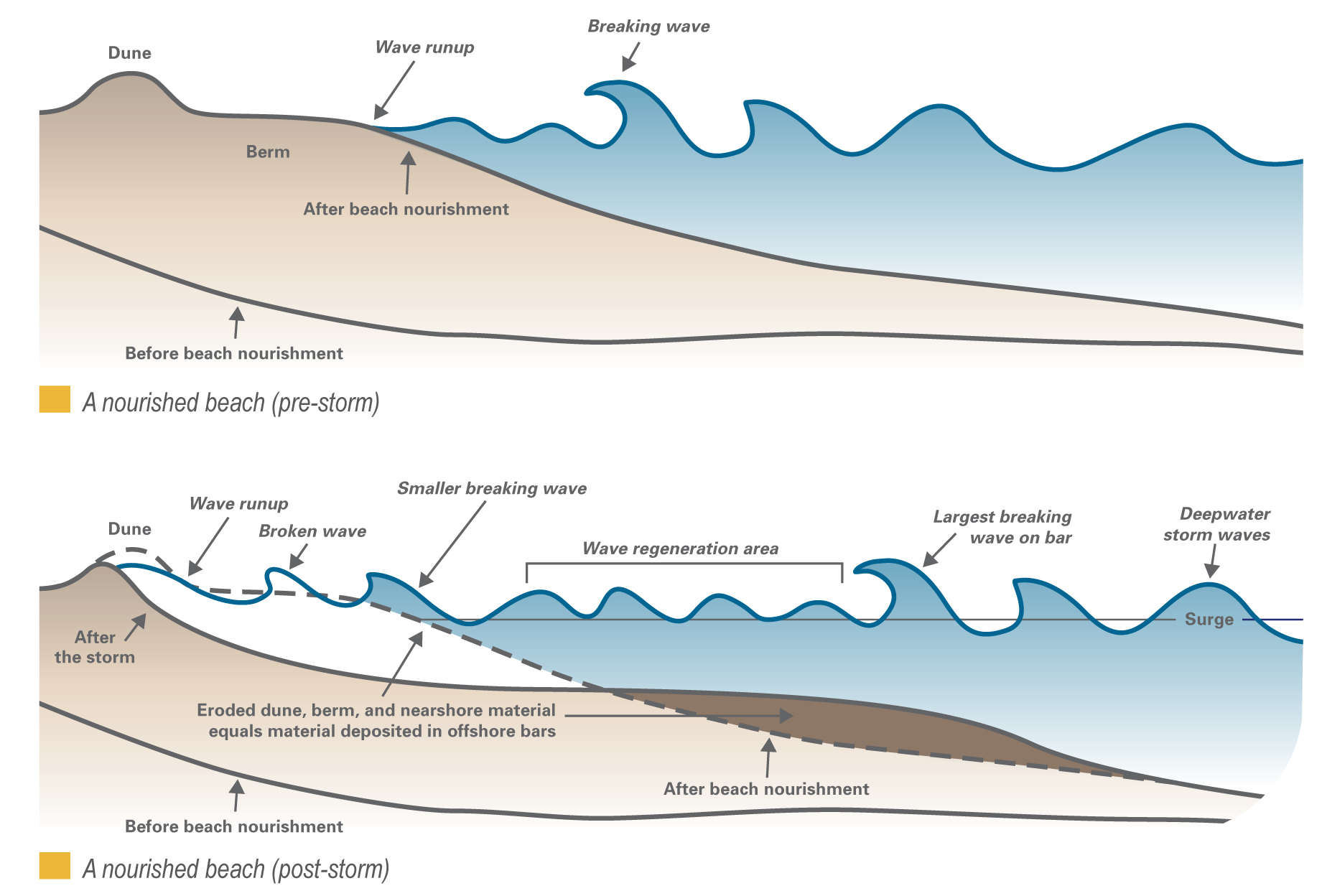
Per the US Army Corps of Engineers North Atlantic Division Website, "Coastal engineers expect that large storms will induce sediment transport from the nourished beach and move sand offshore. When this happens, waves begin to break farther from the shoreline, thus weakening their force before they reach the shoreline itself. In this way, beach nourishment projects help protect dunes and property from further erosion, decrease flooding, and limit how far ashore storm surge will go. A wide, flat beach berm with a sufficient volume of sand keeps the erosive power of the waves from reaching and destroying the dunes and structures and can reduce damages significantly from waves, inundation, and erosion. Without beach nourishment, the starting point for damage would be farther onshore; a nourished beach, with sufficient sand volume and healthy dunes, absorbs the storm's energy, even during slow-moving storms, and helps prevent damages to structures and infrastructure."

How beach nourishment works when a storm comes ashore

North Atlantic Division, U.S. Army Corps of Engineers. (2021). How beach nourishment works when a storm comes ashore. Retrieved from https://www.nad.usace.army.mil/Media/Images/igphoto/2001018727/ 

How long does beach nourishment last?

The answer to this question varies. Natural erosion and storms are a fact of life along the coast, specifically in Oak Island and Caswell Beach. As a result, beach nourishment is an ongoing effort for our areas. Typically the Town of Oak Island and the federal government will work to coordinate nourishment efforts during the off season so as to limit the interference with our area vacationers and seasonal guests. In addition, certain projects must be coordinated for a timeframe outside of turtle nesting season due to the area's designation as a protected nesting habitat. Projects range from a few weeks to mutiple months dependent upon the nature of the project and the size of the area to be nourished. 

Will the beach nourishment project affect my vacation?

Simply put, it may. Projects vary in time frame and location along the island. Some projects could affect a guest's entire stay while others may only cause a 2-day interference. It just depends.

If you are traveling to the island, and staying in an area where there is a potential of an active work zone then you may be affected by the nourishment project. During dredging projects, work may occur 24 hours per day, 7 days per week with active sand pumping. Other projects like sand sifting and redistribution may only occur during normal business hours. You may experience interruptions in direct beach access, construction noises and nighttime illumination.

  • Direct Beach Access Interruption: This mainly affects guests who are oceanfront or 2nd row. (Example: If the project does work in a 1,000-foot area then that 1,000-foot area will be blocked to the public including any direct access within that zone. Ramps and walkways are typically installed once the work zone passes so that guests may access the beach going over the pipeline which remains on the beach until the entire project is complete.)
  • Construction Noises: Equipment is used to dredge the sand from the coastline and pump it on to the beach. Dumptrucks and other construction vehicles are then used to push the sand to recreate the dune structures and to flatten the wider beach areas.
  • Nighttime Illumination: If the work is a continuous process, you may experience illumination from construction lights and spotlights during the night shifts.

Typically, projects move quickly and as soon as an area is completed, the 1,000-foot work zone proceeds down the island. 

What should I expect if I travel to an area directly affected by a nourishment project?

  • Beach closures may be possible on a larger or smaller area scale meaning you could deal with them for a few days of your stay, all of your stay, or quite possibly not at all. 
  • Public ramps/walkovers are usually installed approximately every 500 feet after an active work zone has passed. These ramps are installed over the existing pipeline as it will remain on the beach until the project is complete. Direct beach access from oceanfront and/or 2nd row properties may be inaccessible during any project. MRA cannot guarantee direct beach access during beach nourishment projects.
  • Beach accesses outside of the active work zone may experience increased traffic and crowding due to the additional visitors being diverted from active work zones.
  • Public parking may be limited. The additional visitors diverted to open beach accesses could cause heavier traffic at the open accesses. In addition, the Town uses some open accesses and side street parking to store sand when they plan to sift and redistribute it. (*Please be aware of public parking rules and regultaions as MRA cannot be held responsible if your car is towed or citations received for violations.)
  • Temporary construction noises, beeping and/or back-up safety alarms of construction equipment
  • Equipment lights and spotlights used during the evening hours

What does this mean if I have rented an oceanfront or 2nd row home where work is occurring?

Please refer to the "What should I expect if I travel to an area directly affected by a nourishment project" question above. You may experience temporary disruption in direct beach access while the active work zone passes in front of the property. As work continues, the zone will pass by the home. 

While MRA understands the inconveniences this may cause, please note that the situation is out of our control and controlled by local, state and federal governments and agencies. Should you have questions, please contact us at information@rudd.com.

Are any beach nourishment projects planned/happening on the island?

For up to date information on current and upcoming projects, please visit the Town website.

TOWN OF OAK ISLAND TOWN OF CASWELL BEACH